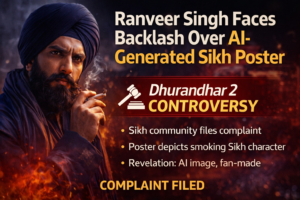
The buzz around Dhurandhar: The Revenge has taken an unexpected turn. While the film has been gaining attention for its scale and performances, it is now facing controversy linked to a viral poster that has sparked outrage within the Sikh community.
At the center of the issue is actor Ranveer Singh, whose alleged depiction in the poster has led to formal complaints and growing public debate.
What Sparked the Controversy?
The issue began when a poster started circulating online showing a character resembling Ranveer Singh in traditional Sikh attire, including:
- Turban (Dastaar)
- Long beard
- Kara (steel bracelet)
However, what triggered strong reactions was the depiction of the character holding a cigarette.
Members of the Sikh community objected to this portrayal, stating that it goes against core religious principles, where tobacco consumption is strictly prohibited.
Formal Complaint Filed in Mumbai
The matter escalated when a complaint was filed at Mulund Police Station in Mumbai by Sardar Gurjyot Singh, representing the organization Sikhs in Maharashtra.
The complaint highlighted:
- Hurt religious sentiments
- Misrepresentation of Sikh identity
- Disrespect towards Sikh traditions and values
The group has demanded:
- Immediate removal of the poster
- Halt on its circulation
- Suspension of the film’s screening until corrective action
- Legal action against those responsible, including the makers and lead actor
Religious Concerns Explained
The Sikh community emphasized that:
- Tobacco is considered a serious violation (Bajjar Kurehit) in Sikhism
- The turban is a sacred symbol of faith and identity
- Combining these elements in such a portrayal is seen as deeply disrespectful
The complaint also referenced the teachings of Guru Gobind Singh, underlining the importance of maintaining the sanctity of Sikh symbols.
Social Media Reaction and Viral Debate
The controversy gained further traction after Paramjit Singh Sarna shared a detailed post on X (formerly Twitter), criticizing the imagery.
His post described the portrayal as:
- Offensive
- Misleading
- A distortion of Sikh beliefs in front of a global audience
The issue quickly went viral, leading to widespread discussion online.
The Twist: Was the Poster Even Real?
As the debate intensified, an important detail emerged.
Several users pointed out that:
- The poster was not official
- It was AI-generated by fans
- The film does not even feature a song titled “Pralay,” which was mentioned in the viral claim
This revelation changed the narrative, raising concerns about how AI-generated content can spread misinformation and trigger real-world consequences.
No Official Response Yet
As of now, the makers of Dhurandhar: The Revenge have not released any official statement addressing the controversy.
This silence has left room for speculation and further debate.
The Bigger Issue: AI, Misinformation and Responsibility
This incident highlights a growing challenge in the digital era.
With AI tools becoming more accessible:
- Fake posters and visuals can look highly realistic
- Misinformation can spread rapidly
- Public sentiment can be influenced before facts are verified
For filmmakers, celebrities, and audiences, this raises an important question about responsibility and verification in the age of AI-generated content.
Final Thoughts
The Dhurandhar 2 controversy is not just about a film or a poster. It reflects a larger issue where technology, religion, and public perception intersect.
While respecting religious sentiments is essential, it’s equally important to verify the authenticity of content before reacting.
As AI continues to evolve, such incidents may become more common, making awareness and accountability more important than ever.