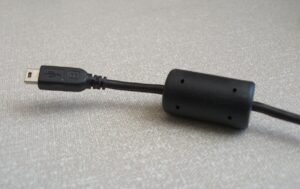
If you’ve used a laptop charger, chances are you’ve seen a round, cylindrical bump somewhere along the cable. A few years ago, these were even common on phone charging cables. Most people ignore it or assume it’s just part of the design. In reality, this small piece plays a key role in keeping your device safe.
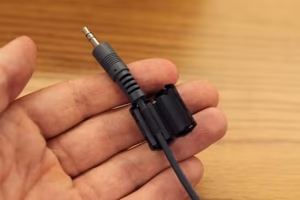
That cylinder is called a Ferrite Bead or Ferrite Choke, and it quietly protects your phone or laptop every time you plug it in.
What Exactly Is a Ferrite Bead?
The black cylindrical part is made of ferrite, a type of magnetic material. Its job is simple. It reduces electrical noise that travels through the cable when current flows.
When a charger supplies power, it isn’t always smooth. It can create high-frequency signals that travel along the wire. If these signals reach your device, they can interfere with the internal circuitry. The ferrite bead sits on the cable to block those unwanted signals so only clean, stable power reaches your device.
Many people think this piece is a fuse, but it’s not. A fuse cuts the current during a fault. A ferrite bead filters the current to prevent interference.
Why Is This Tiny Part So Important?
Even though it looks insignificant, the ferrite bead offers several real benefits.
1. Prevents device glitches
Without it, the high-frequency noise in the cable can disrupt your device. This interference may cause issues like random freezes, lag, or touch response delays.
2. Protects sensitive circuits
Modern electronics are delicate. Noise from the cable can cause small disruptions in how the internal components communicate. The bead keeps that noise away from the device.
3. Stabilizes charging and data transfer
If you’ve ever had a cable that interrupts charging or fails to transfer data, electrical noise is often the reason. A ferrite bead helps keep the signal clean.
4. Reduces electromagnetic interference
Cables without noise control can interfere with nearby devices. The bead keeps your charger from creating unwanted radio interference.
In short, this tiny circle on your charger acts like a silent bodyguard for your device.
Why Don’t Most Chargers Have It Anymore?
If you don’t see a ferrite bead on your new charger, that’s not a problem. Today’s chargers use more advanced internal circuits that already filter electrical noise. That makes the external bead unnecessary.
You’ll still find ferrite beads on certain appliances that draw heavy power like:
Geysers
Microwaves
Monitors
Some desktop power cables
These devices generate stronger electromagnetic noise, so the extra filter is still helpful.
Final Thoughts
Most people never notice the ferrite bead on their charger cable or assume it’s just a random design choice. In reality, it has a clear purpose. It helps block electrical noise, protects your device’s internal circuits, and ensures smooth charging and stable performance.
It may be small, but it has played a major role in device safety for years.
If your cable doesn’t have one today, don’t worry. It usually means your charger already has advanced filtering built in.
Disclaimer: This article is based on information sourced and adapted from Dainik Jagran. All rights belong to their respective owners.