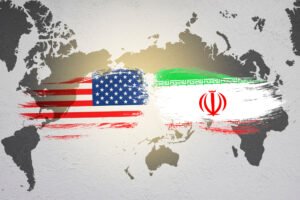
Tensions between the United States and Iran appear to be reaching a breaking point, with Washington reportedly considering military action in the coming days. While potential targets inside Iran are relatively clear, the consequences of a strike are far less predictable.
If last-minute diplomacy fails and US President Donald Trump authorises military action, the region and the world could face several very different outcomes. Here are some of the most discussed scenarios.
1. Limited Strikes and a Democratic Transition
In the most optimistic scenario, US air and naval forces carry out carefully planned, precision strikes aimed at Iran’s military infrastructure. Targets could include bases linked to the Islamic Revolutionary Guard Corps, the Basij paramilitary network, ballistic missile facilities, and elements of Iran’s nuclear programme.
Under this outcome, civilian casualties would be minimal, and Iran’s already weakened leadership could collapse. Supporters of this view argue that such a collapse might eventually open the door to democratic reform, allowing Iran to reintegrate with the international community.
However, history offers reasons for caution. Western military interventions in Iraq and Libya removed authoritarian regimes but led to prolonged instability and violence rather than smooth democratic transitions. Even so, some point to Syria’s 2024 revolution, which unfolded without direct Western military involvement, as evidence that different outcomes are possible under the right conditions.
2. Regime Survives but Softens Its Policies
Another possible outcome is that Iran’s leadership remains in power but is forced to change course. Often compared to the “Venezuelan model,” this scenario assumes that a swift and forceful US strike weakens the regime enough to compel moderation rather than collapse.
In this case, the Islamic Republic would continue to govern, disappointing many Iranians who seek fundamental change. However, Tehran might scale back support for armed groups across the Middle East, slow or halt its nuclear and missile programmes, and ease its crackdown on domestic protests.
This scenario is widely viewed as unlikely. Iran’s leadership has resisted external pressure and internal dissent for nearly five decades, and critics argue it has shown little willingness or ability to reform meaningfully at this stage.
3. Collapse of Civilian Rule and Rise of Military Control
Many analysts believe this is the most probable scenario if US strikes take place. While public dissatisfaction with Iran’s leadership is widespread, the state’s powerful security apparatus remains intact and deeply invested in preserving control.
Protests over the years have weakened the regime but failed to topple it, largely because there have been no major defections from the security forces. Those in power have consistently demonstrated a readiness to use extreme force to survive.
In the chaos following US military action, Iran could see the emergence of a hardline military government dominated by figures from the IRGC. Rather than leading to democracy, this outcome could entrench authoritarian rule under a more overtly militarised leadership.
These scenarios highlight the enormous uncertainty surrounding any potential US strike on Iran. While some outcomes promise reform or moderation, others risk deepening instability, reinforcing hardline rule, or reshaping the Middle East in unpredictable ways.