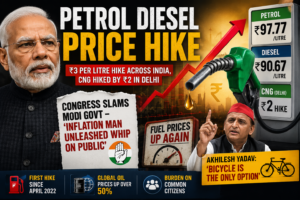
The latest petrol and diesel price hike announced on May 15 has triggered sharp political reactions across India, with opposition parties launching a strong attack on the Narendra Modi-led central government over rising fuel costs and inflation concerns.
The Centre increased petrol and diesel prices by ₹3 per litre across the country, marking the first major fuel price revision in nearly two years. Soon after the petrol and diesel hike, CNG prices in Delhi were also increased by ₹2.
The opposition, led by the Indian National Congress, accused Prime Minister Narendra Modi of burdening common citizens immediately after the completion of assembly elections in several states.
The fuel price increase has once again brought inflation, crude oil prices, and government fuel policies into the national spotlight.
Congress Attacks Modi Government Over Fuel Price Hike
The Congress party strongly criticised the Union government following the fuel price revision.
In a sharp political statement, Congress accused Prime Minister Narendra Modi of unleashing what it described as an “inflation whip” on the public.
The party said:
“Inflation Man Modi has once again unleashed the whip on the public today. Petrol and diesel have been increased by 3-3 rupees. Meanwhile, CNG prices have also been raised by 2 rupees. Elections over – Modi’s extortion begins.”
Congress also linked the timing of the fuel hike to the recent assembly elections held in:
- Assam
- Kerala
- Tamil Nadu
- West Bengal
The opposition alleged that the government delayed the fuel price increase until the elections concluded.
Fuel Prices Increased Across India
State-owned oil marketing companies increased fuel prices nationwide on May 15.
Revised Fuel Prices In Delhi
| Fuel Type | Previous Price | New Price |
|---|---|---|
| Petrol | ₹94.77/litre | ₹97.77/litre |
| Diesel | ₹89.67/litre | ₹90.67/litre |
At the same time, CNG prices in Delhi also increased by ₹2.
The move comes after nearly four years of limited fuel price revisions despite rising international crude oil prices.
First Petrol Diesel Price Hike Since April 2022
This marks the first major increase in petrol and diesel prices since April 2022.
Although fuel prices remained largely frozen during this period, the government had announced a one-time reduction of ₹2 per litre in March 2024 just before the Lok Sabha elections.
Back in April 2022, state-owned fuel companies including:
- Indian Oil Corporation
- Bharat Petroleum
- Hindustan Petroleum
had effectively paused daily fuel price revisions in order to protect consumers from massive international oil price volatility following Russia’s invasion of Ukraine.
The oil companies reportedly suffered heavy losses during the first half of the 2022-23 fiscal year before recovering some of those losses when global oil prices softened later.
Why Have Petrol And Diesel Prices Increased?
According to industry sources, the latest fuel price increase was driven primarily by a sharp rise in global crude oil prices caused by the ongoing conflict in West Asia.
India imports a large percentage of its crude oil requirements, making domestic fuel prices highly sensitive to international market movements.
Crude Oil Price Surge
- India’s imported crude basket averaged around USD 69 per barrel in February
- Following the West Asia conflict, prices surged to around USD 113-114 per barrel
That represents an increase of more than 50 percent in crude oil costs.
Industry sources also stated that the ₹3 hike represents only a fraction of the total increase actually required to fully offset rising global energy prices.
PM Modi’s Appeal For Austerity Measures
The fuel price increase comes only days after Prime Minister Narendra Modi appealed to citizens to adopt austerity measures in order to reduce India’s import burden.
The Prime Minister had urged people to help conserve foreign exchange reserves by reducing imports of:
- Crude oil
- Precious metals
The government has repeatedly highlighted global geopolitical tensions and rising international energy prices as major reasons behind economic pressure.
Akhilesh Yadav Says ‘Bicycle Is The Only Option’
Akhilesh Yadav also reacted strongly to the fuel price hike.
The Samajwadi Party chief suggested that people should shift towards bicycles as fuel costs continue to rise.
In a post on X, Akhilesh Yadav wrote:
“If you want to move forward, the bicycle is the only option.”
The statement also carried political symbolism because the bicycle is the election symbol of the Samajwadi Party.
Opposition Questions Timing Of Fuel Price Revision
The opposition has repeatedly questioned why fuel prices remained unchanged during election periods and increased shortly afterwards.
The recent assembly elections took place across several states between April 9 and April 29, with results announced on May 4.
Political critics argue that the government intentionally delayed price revisions until after polling concluded to avoid voter backlash.
However, government supporters and industry experts argue that fuel pricing is heavily dependent on international market conditions and financial sustainability for oil companies.
Impact Of Rising Fuel Prices On Common Citizens
Fuel price hikes generally have a wider economic impact beyond just transportation costs.
Higher petrol and diesel prices often lead to:
- Increased logistics expenses
- Rising food prices
- Costlier public transportation
- Higher inflation pressure
- Increased household expenses
The simultaneous rise in CNG prices also adds further pressure on middle-class families and commercial vehicle operators.
Many economists believe that persistent global crude oil volatility could continue influencing inflation trends in India over the coming months.
Global Conflicts Continue To Impact Indian Fuel Prices
The latest price increase once again highlights how global geopolitical tensions directly affect domestic fuel rates in India.
The Russia-Ukraine conflict had already disrupted global energy markets over the last few years. Now, the conflict in West Asia has added fresh uncertainty to crude oil supplies and pricing.
As India remains one of the world’s largest crude oil importers, fluctuations in international oil markets continue to impact domestic consumers.
Final Thoughts
The ₹3 petrol and diesel price hike has triggered fresh political debate over inflation, fuel taxation, and economic pressure on common citizens.
While opposition parties accuse the Modi government of increasing prices immediately after elections, the government and oil companies continue pointing toward rising global crude oil prices and geopolitical instability as the main reasons behind the decision.
With crude oil prices still volatile and inflation concerns growing, fuel pricing is likely to remain a major political and economic issue in the months ahead.